Water heater leaking? What to do first
If you smell gas
Leave the house immediately. Do not turn lights or appliances on or off, and do not unplug things. From outside, call 911 and your gas utility (Washington Gas for most of this area). Come back to the water steps only after the gas emergency is cleared.
Quick answer (water leak, no gas odor): Stop the water to the heater if you can do so safely, then cut the power or the gas control, contain what has already leaked, and arrange a repair-or-replace look. A leak from the tank shell almost always means a new unit. A leak at a fitting, drain valve, or TPR valve is sometimes a repair.
Request help on a leaking heater Call (571) 500-8649
What to do, in order
Stop the water
On most tanks, a dedicated cold-water shutoff sits on the pipe at the top of the heater (often a lever handle on a ball valve, or a round hose-bib-style valve). Turn it off (lever perpendicular to the pipe; round handle clockwise).
If you cannot find that valve, or it will not close, shut the main water to the house.
You do not have to drain the tank unless a plumber tells you to. If you do drain it later, use the drain valve with a hose to a floor drain or a sink, and be careful — the water may be very hot.
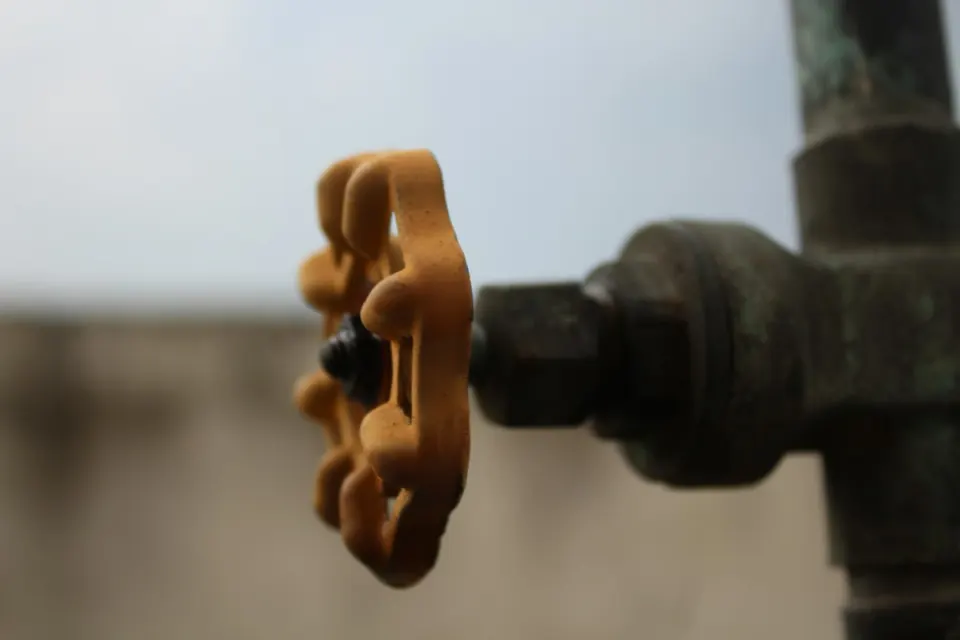
Example photo (licensed stock). Cut power or gas (after the water is off, and only if there is no gas odor)
- Electric: Turn off the breaker labeled for the water heater at the panel. Do not stand in water to do this. If the area around the panel or the heater is wet, skip this step and wait for a plumber.
- Gas: If there is no gas smell and you can reach the control, turn the gas control to Off. If you are not sure, leave it and wait. Never cap or plug a relief valve, and never use a flame to “check” for a leak.
Contain the water and protect the room
Move rugs and stored items. Use a pan, towels, or a wet-vac if you have one. If the heater is in a closet on an upper floor, check the ceiling below. A drain pan that is already overflowing is a clue the drain line is clogged or was never piped to a safe place.
Look, don’t dismantle
From a dry place, note where the water is coming from if you can see it:
- Base of the tank / tank shell → plan on replacement
- Inlet or outlet fittings, drain valve, or a loose connection → often a repair
- TPR (temperature and pressure relief) valve or its discharge pipe → may be the valve, high pressure, a missing or failed expansion tank, or a thermostat problem — not automatically a new tank
Take photos only if it is safe: the whole unit, the leak area, and the rating plate.
Arrange the next step
Send those photos and the city or ZIP on the quote form, or call Call (571) 500-8649. If the unit has already failed and has to come out, Virginia allows emergency replacement work to start, with the permit filed by the end of the next working day (13VAC5-63-80). The permits guide explains which office serves your address. We walk you through the permit steps.
What not to do
- Do not cap or plug the TPR valve
- Do not keep running a tank that is leaking from the shell
- Do not stand in water to reset a breaker
- Do not “test” gas with a flame
- Do not assume an overflowing pan means the tank is fine
Need a look at a leaking heater? Request a quote, or read the repair or replace guide.
Request a quoteFAQ
Is a leaking water heater an emergency?
A spreading leak, a closet on an upper floor, or any gas odor should be treated as urgent. A slow drip at a fitting is still worth shutting the local valve and getting it looked at promptly, even if the carpet is not soaked yet.
Can I just tighten a fitting myself?
A slightly loose connection is sometimes obvious, but do not wrench on old valves if you are not sure — you can turn a drip into a break. Shut the water off first.